

Kava vs. Coffee: A Calmer Alternative to Your Morning Buzz
Jun 09, 2026
Coffee wakes you up by switching off the part of your brain that tells you to slow down. Kava does almost the opposite — it gently turns the calm up. They're not two versions of the same drink, and swapping one for the other isn't a like-for-like trade. But if your relationship with caffeine has started to feel more like jitters, an afternoon crash, and a 2 a.m. ceiling stare than a clean lift, kava is worth understanding. Here's how the two actually compare.
Quick answer: Coffee is a stimulant — caffeine blocks adenosine, your brain's "wind down" signal, which raises alertness but can also spike cortisol and anxiety. Kava is a relaxant — its kavalactones gently support GABA activity, easing tension without sedating you or clouding your head. Kava won't replace coffee's energy kick, but it's a strong swap for your afternoon cup, your wind-down ritual, or any time caffeine leaves you wired and anxious. And if you'd rather not choose, kava stirs right into coffee — keeping the alertness while taking the edge off the jitters.
Kava vs. Coffee: What's the Core Difference?
They pull your nervous system in opposite directions. Caffeine is a stimulant that works by removing the brakes — it blocks the receptors that normally tell your brain to rest. Kava is a relaxant that works by gently pressing the brakes — its active compounds support the calming signals already in your brain. One borrows energy you'll pay back later; the other lowers the background hum of tension without knocking you out.
That difference is why this isn't a straight substitution. If you want raw alertness to power through a 7 a.m. inbox, kava is the wrong tool — it won't make you more productive in the way a double espresso does. But if what you're really after is the warm mug, the pause, the ritual, and a calmer baseline, kava delivers that far better than a fourth cup of coffee ever could.
How Caffeine Actually Works (And Why It Can Backfire)
Caffeine's main job in the brain is to block adenosine receptors. Adenosine is the molecule that builds up through the day and makes you feel progressively more tired — it's your brain's natural "you've been awake a while" signal. Caffeine slots into adenosine's parking spot so the tiredness signal can't land, which is why you feel alert.[1] The catch: you haven't actually created energy. You've just hidden the fatigue, and it's still accumulating underneath.
Blocking adenosine also nudges your stress response. Research shows caffeine can raise cortisol and has measurable anxiogenic (anxiety-promoting) effects at higher doses, which is the biochemical version of "I had one too many coffees and now I'm vibrating."[2] For people who are already prone to anxiety, that nudge is the part of coffee that quietly works against them.
The half-life problem
Caffeine sticks around longer than most people realize. Its average half-life in a healthy adult is about 5 hours, and individual clearance varies up to 40-fold depending on genetics, smoking, and other factors.[1] A 5-hour half-life means that an afternoon coffee at 3 p.m. still has roughly a quarter of its caffeine circulating at bedtime — which is how a single innocent cup turns into a restless night and a groggy morning that demands... more coffee.
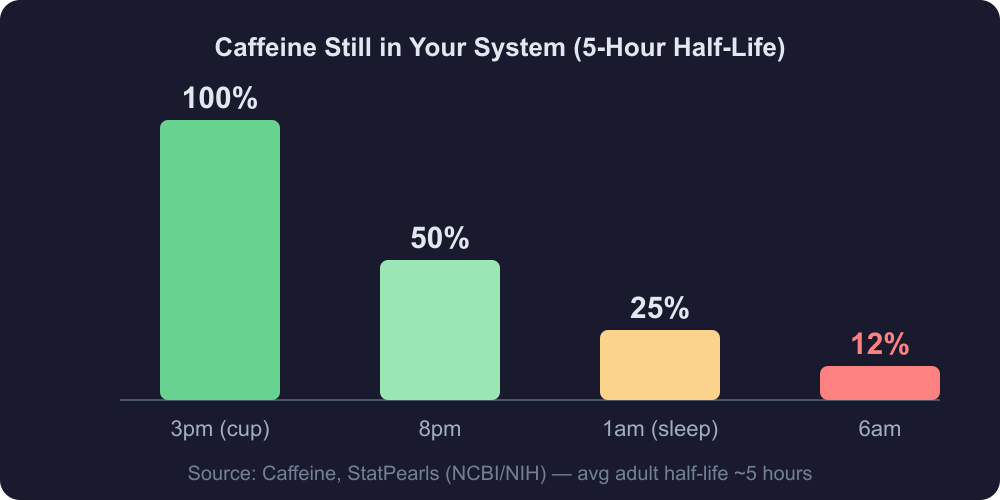
An afternoon coffee leaves about a quarter of its caffeine in your system at bedtime — the hidden reason the cycle repeats.
How Kava Works Differently
Kava goes after the calm side of the equation. Its active compounds — kavalactones — act as positive modulators of GABA-A receptors, the same calming system the brain uses to ease tension and quiet an overactive mind.[3] Where caffeine removes the brakes, kava gently strengthens them. The result many people describe is a relaxed, sociable, clear-headed calm — not the foggy sedation of a sleeping pill, and not the wired edge of espresso.
Importantly, kava does this without the stimulant baggage. There's no cortisol spike, no jitters, and no looming crash to caffeinate your way out of. A double-blind clinical trial found kava produced a significant reduction in anxiety symptoms versus placebo,[4] and many people reach for it specifically for that even-keeled feeling. If you're new to how kavalactones produce that effect, the kavalactones guide breaks down the chemistry.
Can Kava Replace Your Morning Coffee?
Honestly? Not as a one-for-one energy swap — and we'd rather tell you that than oversell it. Kava is calming, not stimulating, so it won't hand you the alert, switched-on push that gets most people out the door in the morning. What it can do is replace the parts of your coffee habit that aren't serving you: the second and third cups that tip you into anxiety, the 3 p.m. cup that wrecks your sleep, and the ritual itself when you want the warm-mug pause without the chemical cost.
A realistic, popular pattern looks like this: keep one morning coffee if you love it, then swap your afternoon caffeine for kava. You get the ritual and a genuine shift toward calm in the back half of the day — and you protect your sleep, which is what actually fixes your morning energy. For people whose coffee reliably triggers anxiety, an earlier and fuller switch often makes sense.
Coffee vs. kava at a glance
What it does: Coffee stimulates (blocks adenosine); kava relaxes (supports GABA).
How you feel: Coffee — alert, sometimes jittery or anxious; kava — calm, social, clear-headed.
The downside: Coffee — crash, tolerance, sleep disruption; kava — a brief learning curve before you feel it fully.
Best time: Coffee — morning; kava — afternoon, evening, or social occasions.
After-effects: Coffee — possible crash and poor sleep; kava — no hangover, no crash.
Or Don't Choose: Add Kava Straight to Your Coffee
Here's the option most people miss: you don't have to pick one. Because caffeine and kava work on different systems — caffeine blocks the adenosine signal that makes you feel tired,[1] while kavalactones support the calming GABA system[3] — you can put both in the same cup. The caffeine keeps the alertness; the kava rounds off the jittery, over-caffeinated edge, so you get the lift without as much of the wired feeling.
That's exactly what our vanilla-hazelnut snap pack is built for — a coffee-ready additive you stir straight into a hot or iced cup. The vanilla-hazelnut profile is made to complement coffee rather than compete with it, so it drinks like a smoother, slightly sweeter brew that still wakes you up. One pack per cup is an easy place to start.
If your coffee habit mostly works and the jitters (or the mid-morning crash) are the only real problem, this is the simplest fix of all — you keep the ritual, keep the caffeine, and let the kava take the edge off. Many people find a kava-spiked coffee delivers the focus they want with far less of the afternoon anxiety a second or third straight cup tends to bring.
Who Should Consider Switching?
Kava tends to be most worthwhile for a few specific groups. If coffee makes you anxious or jittery, you're feeling caffeine's cortisol nudge — and a calming drink is a logical counter.[2] If you crash hard every afternoon, that's the adenosine you blocked earlier arriving all at once, and reaching for kava instead of another coffee breaks the loop. And if caffeine is quietly stealing your sleep — likely, given that 5-hour half-life — moving your afternoon cup to kava is one of the simplest fixes available.[1]
Kava is also a natural fit for the sober-curious and anyone building an alcohol-free evening routine, since it offers a way to unwind that doesn't lean on either caffeine or alcohol. Just note the usual responsible-use guidance: kava is for relaxation, not a treatment for any medical condition — the responsible use guide covers dosing and what to check on a label, and NCCIH maintains a helpful overview of kava safety.[5]
How to Make the Switch Without a Caffeine Crash
If you quit caffeine cold turkey, you'll likely get a withdrawal headache and a few flat days — that's the adenosine you'd been suppressing flooding back. The smoother path is gradual:
Taper, don't quit. Drop one cup at a time over a week or two rather than stopping all at once.
Swap the afternoon cup first. It's the one most likely to be hurting your sleep, and replacing it has the fastest payoff.
Use a consistent kava format. Kava gummies and snap packs deliver a reliable, labeled kavalactone dose — handy when you're learning how kava feels for you.
Give kava a few sessions. Many people don't feel kava fully on the first try; that's normal. The reverse tolerance guide explains why and how to prime through it.
Protect your sleep. The whole point is steadier natural energy. Better sleep is what reduces your caffeine dependence in the first place.
Frequently Asked Questions
Does kava give you energy like coffee?
No. Kava is a relaxant, not a stimulant — it won't produce the alert, switched-on feeling caffeine does. Its value is the opposite: easing tension and helping you feel calm and social. Many people use it to replace afternoon or evening caffeine, not their morning wake-up cup.
Can I drink kava and coffee on the same day?
Many people do — for example, coffee in the morning and kava in the afternoon or evening. They act on different systems, so they don't directly cancel each other out. Keep your caffeine earlier in the day to protect sleep, time your kava for the afternoon or evening (the duration guide covers how long the calm lasts), and follow your kava product's dosage guidance. If you take any medications, check with a healthcare provider first.
Can I add kava straight to my coffee?
Yes — many people stir a kava snap pack into a cup of coffee. Because caffeine and kava act on different systems, you keep the alertness from the coffee while the kava helps smooth out the jitters. A coffee-ready format like the vanilla-hazelnut snap pack is made to mix in and complement the flavour — start with one pack per cup.
Is kava safer than coffee?
They carry different considerations rather than one being universally "safer." Caffeine is well studied and fine in moderation for most people, but it can worsen anxiety and disrupt sleep. Kava should be noble kava, used responsibly per label guidance, and isn't recommended alongside alcohol or certain medications. Neither is a treatment for any medical condition.
Will switching to kava help my anxiety?
Cutting back on caffeine can reduce caffeine-driven jitters and cortisol spikes, and kava is widely used for relaxation, with clinical research showing reduced anxiety symptoms versus placebo.[4] That said, kava is not a treatment for any anxiety disorder. If anxiety is significantly affecting your life, talk to a healthcare provider.
Ready to give your afternoon cup a calmer counterpart? Kavayn Kava Gummies and Snap Packs deliver a consistent, labeled dose — an easy place to start when you're trading the jitters for a little more calm.
Kava is not intended to diagnose, treat, cure, or prevent any disease. Consult a healthcare provider if you have questions about kava and medications.
Sources
Evans, J. et al. "Caffeine." StatPearls, NCBI Bookshelf (NIH), updated 2024. (Average adult caffeine half-life ~5 hours; CYP1A2 accounts for ~95% of clearance; up to 40-fold inter-individual variation.)
Reviewed in: "Longitudinal Effects of Lifetime Caffeine Consumption on Levels of Depression, Anxiety, and Stress." PMC, 2024. See also Jacobson, K. et al. "Adenosine A2A receptor antagonists: from caffeine to selective non-xanthines." British Journal of Pharmacology, 2022. (Caffeine raises cortisol and has anxiogenic effects at higher doses.)
Chua, H.C. et al. "Kavain, the Major Constituent of the Anxiolytic Kava Extract, Potentiates GABA-A Receptors." PLOS ONE, 2016.
Sarris, J. et al. "Kava in the treatment of generalized anxiety disorder: a double-blind, randomized, placebo-controlled study." Journal of Clinical Psychopharmacology, 2013.
NCCIH. "Kava." National Center for Complementary and Integrative Health (NIH). (Responsible-use and safety guidance.)


