

How Bars Can Add Kava to Their Alcohol-Free Menu (And Why It’s Worth It)
May 26, 2026
Something has shifted on the other side of the bar. Customers are ordering fewer cocktails, asking what's non-alcoholic, and — increasingly — checking whether a venue has anything interesting to offer beyond soda water and juice. For bar owners and beverage managers, that's not a problem to manage; it's an opening. Kava fits that opening better than almost anything else in the non-alcoholic category — and it's easier to add to a menu than most operators expect.
Quick answer: Adding kava to an alcohol-free bar menu meets a real and growing customer demand — 49% of Americans plan to drink less alcohol in 2025, up 44% since 2023.[2] Kava is legal, sessionable, high-margin, and requires minimal staff training to serve. The formats available today make it practical at any type of venue.
The Sober-Curious Shift — Why Bars Need More Options Now
54% of U.S. adults say they drink alcohol — the lowest figure Gallup has recorded in nearly 90 years of tracking, down from 62% just two years ago.[1] That decline is showing up at the bar. Gen Z is leading the change: 65% plan to drink less in 2025, and 41% say they plan to visit a sober bar specifically.[3] These are your next decade of customers.
The business math is straightforward. A customer who orders nothing doesn't generate revenue. A customer who orders two kava drinks at $10–12 each does. The U.S. no/low-alcohol beverage market is forecast to grow 18% in volume annually through 2028,[4] and 40% of restaurants and bars are already expanding their non-alcoholic offerings to capture it.[5] The venues that move first build the habit and the loyalty.
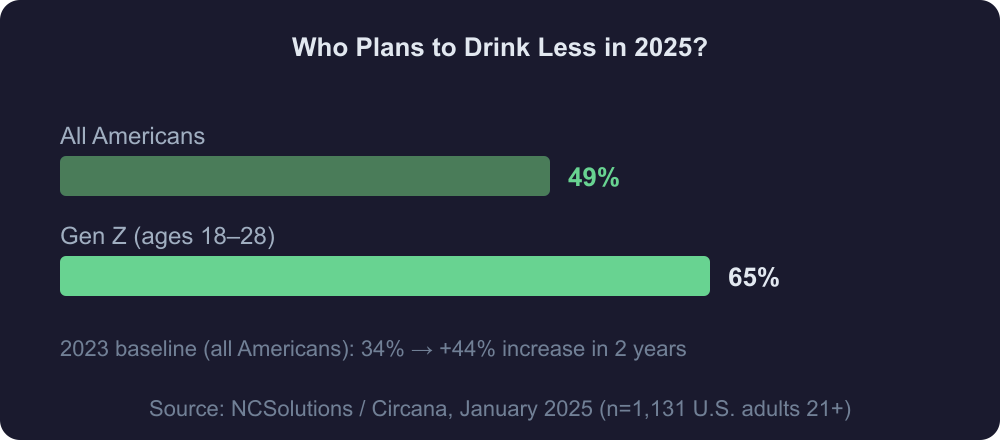
Gen Z and younger millennials are driving the sober-curious shift — exactly the demographic bars are trying to retain.
Why Kava Works on a Bar Menu
Most non-alcoholic options serve a purpose but don't drive repeat orders. Kava is different — it has a functional effect, a social ritual built around it, and a flavor profile that rewards experience. For a bar, that translates directly into table time and reorder rates.
Social ritual without intoxication
Kava's active compounds — kavalactones — produce genuine relaxation and social ease without impairing cognition or coordination. Customers who choose kava aren't settling for a lesser experience; they're choosing a different one. That distinction matters for how you position it, and it matters for how those customers feel about your venue. For a full breakdown of how kava compares to alcohol socially, the detail is there for staff who want to understand it.
Repeat orders — kava is sessionable
A traditional kava session involves multiple small shells over an hour or two, not a single large drink. This mirrors how people drink beer at a bar — socially, slowly, over conversation. A table of four kava drinkers can reasonably order 2–3 rounds each. That's 8–12 drink tickets at a bar without a single person ordering alcohol.
High-margin, low-complexity serving
A well-crafted mocktail can outperform the gross margin of a traditional cocktail — with lower ingredient cost, no liquor license overhead on the pour, and zero post-shift liability for overserving. Non-alcoholic beverages in on-premise venues saw sales grow 30% in 2024,[6] and kava products specifically require minimal preparation: no shaking, no precision pouring, no spirit inventory management for that SKU.
Kava Formats That Work in Bar Settings
The format question is where most bars stall. The right answer depends on your venue type, and there are good options for all of them.
Ready-to-pour shots (Snap Packs)
Kavayn Snap Packs are single-serve extracts that mix with still water in a cup — no prep, no equipment, no training beyond "tear, pour, stir." For a bar that wants to offer kava without committing to a full kava menu, this is the starting point. Keep a few behind the bar, add them to your non-alcoholic menu as a "traditional kava extract," and see how customers respond. Shelf-stable, small footprint, and consistent dosing.
Spirit alternatives in cocktails (Kava Spirits)
Kavayn Kava Spirits are purpose-built for bar use — a non-alcoholic spirit alternative that substitutes into cocktail builds. This opens up the most flexibility for a creative bar menu. A simple starting build that works well with minimal effort:
The Kava Mule: 2 oz Kavayn Kava Spirits · 4 oz ginger beer · ½ oz fresh lime juice · ice · lime wedge garnish. Serve in a copper mug. Clean, familiar presentation. Guests who order it often order a second.
Once your team is comfortable with that, the same spirit substitutes into a Kava Sour (shaken with lemon, simple syrup, and aquafaba for froth) or into a low-ABV Collins with tonic and cucumber. The format scales with your bartenders' creativity.
Traditional shell service (for kava bars or themed events)
If you're running a dedicated kava night, pop-up, or themed event, traditional shell service — a small coconut cup, served at room temperature, consumed in one sip with the optional blessing — creates an experience customers genuinely remember and share. Kava bars across the U.S. grew from roughly 20 locations in 2011 to over 300 by 2023,[7] and the ritual is a significant part of what drives that loyalty. You don't need to replicate a full kava bar to borrow the format for a special night.
Menu Placement and Naming Tips
Where to position kava on the menu
Place kava offerings within your existing non-alcoholic or mocktail section — not in a separate "health drinks" category. Customers who see kava next to thoughtfully built mocktails understand it as a premium choice. Customers who see it isolated in a wellness sidebar don't order it. If your menu has a "low & no" section, lead with kava at the top of that section.
How to describe kava in menu copy
Skip the word "earthy" as a standalone descriptor — it reads as a warning. Instead: "traditional Pacific relaxation drink" or "non-alcoholic spirit with a mild calming effect" gives the right framing. For guests who ask, train staff on one sentence: "It's an ancient Pacific social drink — think of it as the non-alcoholic equivalent of a spirit. You'll feel relaxed and clear-headed." That's enough for most customers. For deeper context to share with curious staff, the Kava 101 guide covers the basics plainly.
Pairing with mocktail builds
Kava pairs best with strong flavor carriers that balance its mild bitterness: ginger, citrus (lime, lemon), pineapple, passionfruit, and coconut all work well. Avoid delicate, floral builds — kava's flavor profile doesn't disappear quietly into rose water. A rule of thumb: if the mixer works in a dark rum cocktail, it'll likely work with Kava Spirits.
What Staff Need to Know
Front-of-house training for kava can be done in under 10 minutes. The key points for servers and bartenders:
-
Kava is a traditional Pacific Island drink, legal in all U.S. states.
-
It produces mild relaxation — not intoxication. Customers stay clear-headed.
-
Effects typically kick in within 20–30 minutes and last 2–3 hours.
-
It's best consumed on its own or with light snacks — not mixed with alcohol.
-
If a guest asks "will I feel anything?" — yes, a gentle calming effect. Not a buzz.
-
Customers with liver conditions or who take regular medications should check with their doctor first.
That covers 95% of table conversations. Staff who want to go deeper can read the responsible use guide.
Getting Started — Where to Source and What to Stock
For a bar adding kava for the first time, the lowest-risk starting point is two SKUs: Snap Packs for a simple, consistent extract offering, and Kava Spirits for cocktail builds. Both are shelf-stable with a straightforward reorder cycle. Start with enough for one week of moderate volume — typically a case of each — and let customer demand drive how quickly you scale.
On the legal side: kava is classified as a dietary supplement by the FDA and is legal to sell and serve across the U.S. Regulations vary in a small number of states, and some municipalities have specific guidance for kava bars operating as standalone venues. For a standard bar adding kava as a menu item, no additional licensing is typically required beyond your existing food and beverage permits — but always verify with your local authority before menu launch.
For bulk or wholesale enquiries, contact Kavayn directly — the team works with hospitality operators on volume pricing and menu support.
Frequently Asked Questions
Is kava legal to serve in bars?
Yes — kava is legal in all 50 U.S. states. It's classified as a dietary supplement by the FDA and requires no special liquor license to serve. A small number of states have specific regulations for standalone kava bars; standard on-premise venues adding kava as a menu item typically need no additional permits. Always confirm with local authorities before launch.
Does kava require any special handling or storage?
No. Kava extract products are shelf-stable at room temperature, require no refrigeration before opening, and have the same handling profile as any dry beverage ingredient. Traditional kava powder should be stored dry and away from heat but presents no special risk. Prepared kava drinks should be consumed within a few hours, like any fresh beverage.
How do guests typically respond to kava on a menu?
Curiosity is the most common first reaction, followed by repeat orders from those who try it. The non-alcoholic beverage category recruited 61 million new consumers globally between 2022 and 2024,[4] and kava's functional profile makes it a standout in a category otherwise dominated by mocktails and NA beer. Venues that describe it well at the point of order convert curious browsers into regulars.
Can kava be served alongside alcohol on the same menu?
Yes — most bars that add kava serve it alongside their regular alcohol menu, positioned as a premium non-alcoholic option. Kava and alcohol shouldn't be mixed in the same drink or consumed together in large amounts, and staff can mention this if asked. The two categories coexist easily on a menu without conflict.
Ready to add kava to your menu? Kavayn Kava Spirits and Snap Packs are available for individual order or wholesale — a practical starting point for any venue.
Sources
-
Gallup. "Drinking Rate at New Low as Alcohol Concerns Surge." August 2025.
-
NCSolutions / Circana. "Nearly Half of Americans Plan to Drink Less Alcohol in 2025." January 2025.
-
NCSolutions / Circana. "Sober Curious Nation: Alcohol Survey." January 2025.
-
IWSR. "Key Statistics and Trends for the US No-Alcohol Market." 2024–2025.
-
TouchBistro. "2025/2026 State of Restaurants Report." 2025.
-
Entegra Procurement Services. "Non-Alcoholic Drinks: Growing Trend for Increased Profits." 2024.
DryAtlas. "The Rise of Kava: Market Dynamics and Future Opportunities." 2024.


