

Kava Reverse Tolerance: Why You Might Not Feel It at First (And What to Do)
May 19, 2026
You tried kava. You followed the instructions, drank the full amount, waited. And felt... not much. Maybe a slight numbing of the lips, maybe nothing at all. If that sounds familiar, you're not alone — and your kava isn't broken. Neither are you. What you likely ran into is one of kava's more unusual properties, and understanding it makes all the difference for whether you stick with it.
Quick answer: Kava reverse tolerance is real and well-documented. Unlike most substances where effects diminish over time, kava often requires 2–5 sessions before users feel its full effects. The main reason is chemistry: kavalactones are fat-soluble compounds that absorb poorly from a single session, and GABA receptors may need repeated exposure to respond fully. It's not a flaw — it's how the plant works.
What Is Reverse Tolerance, and Why Does Kava Have It?
With most substances — alcohol, caffeine, many pharmaceuticals — you develop tolerance: the same dose produces smaller effects over time, so you need more to feel the same result. Kava runs in the opposite direction. Many first-time users feel little to nothing; with repeated sessions, the same dose produces increasingly noticeable effects. That pattern has a name in pharmacology: reverse tolerance, or the priming effect.
This isn't placebo or ritual — it has a biological basis rooted in how kavalactones interact with your body. Understanding that basis makes it much easier to work through the priming period without giving up early. For more background on what kavalactones are and how they affect the body, the kavalactones guide covers the fundamentals.
The Science: Why Kava Takes Time to Work
Kavalactones are fat-soluble compounds
Kavain — the primary kavalactone responsible for kava's relaxing effects — is classified as a BCS Class II compound: low water solubility, but high intestinal permeability.[1] In plain terms: your gut is good at absorbing it, but water alone is a poor vehicle for getting it there. A 2022 human pharmacokinetic study confirmed this directly — taking kavalactones with food actually reduced peak plasma concentration (Cmax) by approximately 50% compared to fasted conditions.[2]
This means that in your first session, if you ate beforehand, you may have absorbed half of what the dose could deliver. That alone explains why many people feel little the first time. The kavalactone content in a single serving of traditionally prepared kava can range from 150 to 500 mg depending on variety, preparation method, and batch — and even at the high end, poor timing and delivery method can cut bioavailable dose significantly.[8]
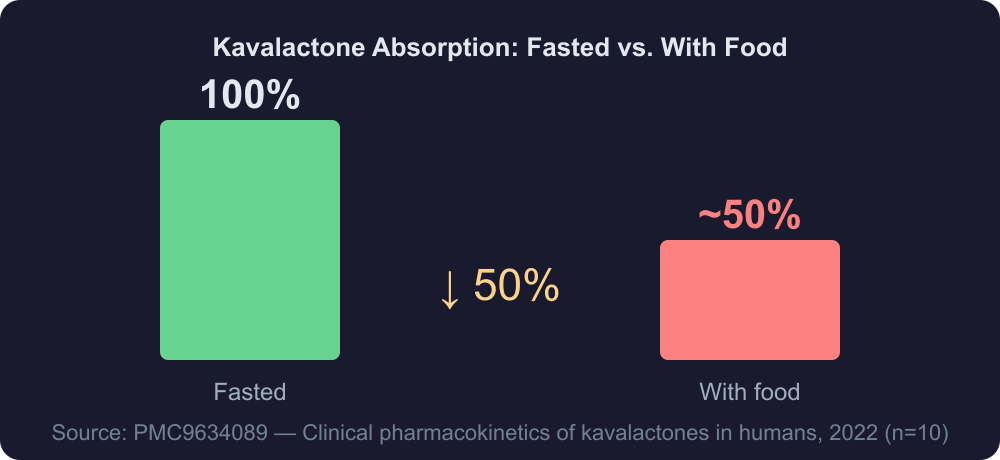
Eating before a kava session can cut the effective dose in half — a common reason first-timers feel nothing.
GABA receptors may need time to respond
Kavalactones work differently from benzodiazepines even though both affect GABA receptors. Kavain is a positive allosteric modulator (PAM) of GABA-A receptors at a binding site completely separate from the benzodiazepine site.[4] Earlier research found that repeated kava exposure may actually increase the number of GABA binding sites in the brain (a process called Bmax upregulation) — meaning your receptors become more responsive over time, not less.[5]
This is the likely cellular-level explanation for reverse tolerance. Your body isn't building resistance; it's building capacity. The practical implication: the first session is not an accurate read of what kava does for you. Sessions two through five are far more informative.
How Long Does the Priming Period Last?
For most people, somewhere between 1 and 5 sessions. A subset of users feel kava clearly on the very first try — typically people who take a higher-quality noble kava on an empty stomach using a well-prepared extract. Many people notice something mild in sessions two or three and feel the full effect by session four or five. A smaller group takes longer, particularly if they're using a less concentrated format or inconsistent preparation.
The clinical trial evidence aligns with this: a 6-week double-blind RCT (n=75) found that kava produced significant anxiety reduction versus placebo, with 26% of the kava group achieving remission compared to 6% on placebo.[6] Those outcomes were measured across weeks, not a single session — confirming that kava's effects accumulate with repeated use rather than hitting a peak on day one.
What Affects Whether You Feel Kava?
Preparation method and format
Traditional water-based kava preparation is a less efficient solvent for kavalactones than many people assume. Five consecutive water extractions of 1g kava powder are insufficient to extract all kavalactones due to limited solubility at room temperature.[8] This is why the traditional method involves vigorous kneading — mechanical action emulsifies the fat-soluble compounds into the water, rather than dissolving them. Done carelessly, you get a fraction of the available kavalactones.
Standardized extracts and kava gummies solve this problem by using extraction methods that fully capture kavalactones and deliver them in a consistent, predictable dose. If you're still not feeling anything after several sessions with traditionally prepared kava, switching to a standardized kava gummy or kava extract snap pack is often the fastest way to confirm whether it's a preparation issue.
Kavalactone concentration
Not all kava products are equal. Noble kava (the variety recommended for regular use) has a specific kavalactone profile that produces the relaxation effects people expect. Tudei kava — a cheaper, lower-quality variety — has a different profile and may genuinely not produce the same experience. The WHO daily guidance is 60–210 mg of kavalactones;[8] many first-time users are unknowingly working with products at the low end or below that range. Checking kavalactone content on the label is the starting point — the kava label guide explains what to look for. For a full breakdown of variety differences, the noble vs. tudei guide is worth reading.
Taking it on an empty stomach
The research is unambiguous on this point: food reduces kavalactone absorption by approximately half.[2] Take kava 2–3 hours after your last meal if possible. If you're using traditional preparation, a small amount of healthy fat (a few nuts, a spoonful of coconut oil) can actually help absorption rather than hurt it — fat-soluble compounds absorb better in a lipid-rich environment. But a full stomach slows gastric emptying and reduces how quickly kavalactones reach your intestinal wall.
Set and setting
Kava's effects are subtle by design — it doesn't override your nervous system the way alcohol does. First-time users in loud, stimulating environments often miss what's happening because there's too much noise to notice the shift. A quiet, relaxed setting makes it far easier to recognize the effect when it arrives: the slight loosening of tension in the shoulders, the easier breathing, the conversation that flows a little more naturally. Many people who "didn't feel kava" the first time tried it at a crowded event. Try it at home first.
Tips to Get Through the Priming Period
- Take it on an empty stomach. 2–3 hours after eating, every session.
- Be consistent. Session spacing matters — 2–4 sessions over 1–2 weeks is more effective than one session every few weeks.
- Use a reliable, standardized format. Kava gummies and snap packs remove dosing variability. Consistent kavalactone delivery each session gives your receptors the repeated exposure they need.
- Start with the right dose, not a higher one. More kava on session one won't shortcut the priming process. Follow the product's guidance and be patient.
- Choose noble kava. If your product doesn't specify noble kava and display kavalactone content, that's information worth having before you continue. The kava basics guide explains why it matters.
Does Kava Build Tolerance Over Time? (The Myth in Reverse)
The short answer is: not the way most people worry about. Kava doesn't produce the kind of escalating dependence seen with alcohol or benzodiazepines. Regular users don't typically need progressively more kava to feel the same effect — some long-term users report needing less over time as their sensitivity stabilizes. The reverse tolerance effect is specific to the priming period and doesn't mean kava becomes progressively stronger forever. Effects level off at a consistent baseline. For a full picture of how long kava's effects last and how they change across sessions, that post covers it in more detail.
Frequently Asked Questions
Is kava reverse tolerance scientifically proven or just anecdotal?
It has a scientific basis. The fat-solubility of kavalactones (BCS Class II, confirmed 2022),[1] the food-absorption interaction (50% Cmax reduction, confirmed 2022),[2] and the proposed GABA receptor Bmax upregulation (1995, replicated in mechanism studies)[5] all support the phenomenon pharmacologically. User reports are consistent with the mechanism — they're not explaining something that doesn't have a physical basis.
Does everyone experience reverse tolerance?
No — some people feel kava clearly on the first session, particularly with high-quality noble kava taken on an empty stomach at a meaningful dose. The priming effect is most common in new users, those using inconsistently prepared traditional kava, or those consuming it with food. It's a spectrum, not a fixed rule.
Should I take more kava if it's not working?
No — doubling the dose on session one won't accelerate the priming process and may cause nausea. Follow the product's dosage guidance and give it multiple sessions before drawing conclusions. If you've had 5+ sessions with quality noble kava, on an empty stomach, using a standardized extract, and still feel nothing — that's a different conversation worth having with a healthcare provider, as individual variation in kavalactone metabolism does exist.
Does the type of kava matter for reverse tolerance?
Yes, significantly. Poor-quality kava or tudei kava may genuinely not produce the effects you're expecting — this isn't reverse tolerance, it's the wrong product. Noble kava with clearly labeled kavalactone content is the baseline for any meaningful priming period. If the label doesn't tell you the kavalactone percentage, you don't know what you're working with.
Take the guesswork out of dosing — Kavayn Kava Gummies and Snap Packs both deliver consistent, labeled kavalactone content so you know exactly what you're getting each session.
Sources
- Sravya, S. et al. "Biopharmaceutical evaluation of kavain in Piper methysticum dried extract: Equilibrium solubility and intestinal permeability in Caco-2 cell model." Journal of Ethnopharmacology, 2022.
- Teschke, R. et al. "Clinical pharmacokinetics of kavalactones after oral dosing of standardized kava extract in healthy volunteers." Journal of Ethnopharmacology, 2022.
- PMC. "Biological Activity, Hepatotoxicity, and Structure-Activity Relationship of Kavalactones." 2021.
- Teschke, R. et al. "Kavain, the Major Constituent of the Anxiolytic Kava Extract, Potentiates GABA-A Receptors: Functional Characteristics and Molecular Mechanism." PLOS ONE, 2016.
- Jussofie, A. et al. "Kavapyrone enriched extract from Piper methysticum as modulator of the GABA binding site in different regions of rat brain." Psychopharmacology, 1995.
- Sarris, J. et al. "Kava in the treatment of generalized anxiety disorder: a double-blind, randomized, placebo-controlled study." Journal of Clinical Psychopharmacology, 2013.
- Sarris, J. et al. "The effectiveness and safety of Kava Kava for treating anxiety symptoms: A systematic review and analysis of randomized clinical trials." Complementary Therapies in Medicine, 2018.
Lebot, V. et al. "Kavalactone content and chemotype of kava beverages prepared from roots and rhizomes of Isa and Mahakea varieties." Journal of Agricultural and Food Chemistry, 2015. See also: NCCIH Kava Overview.


